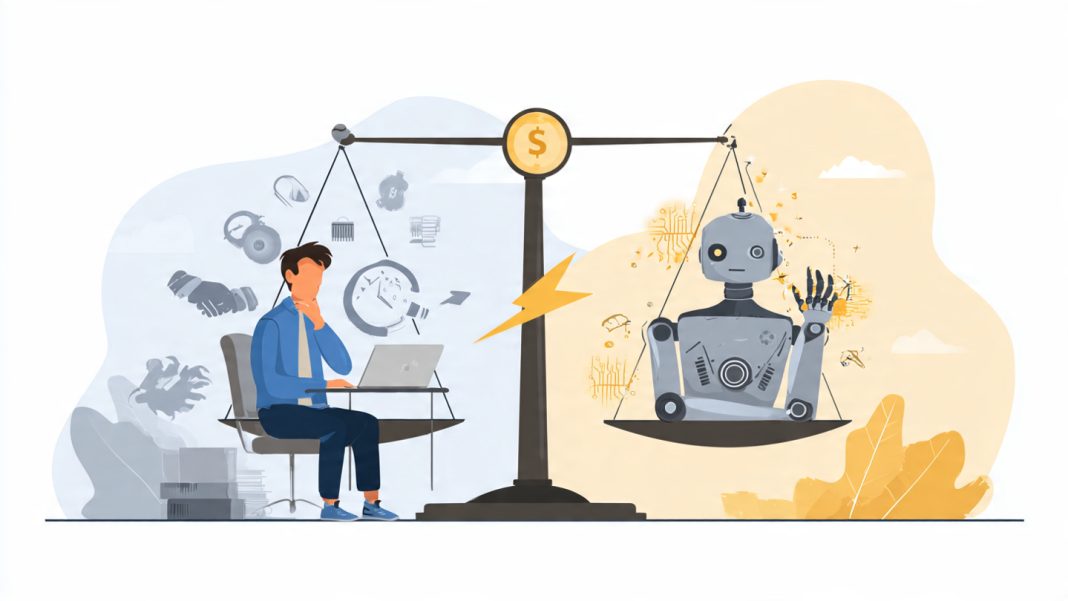
You’re hitting a wall. Your to-do list is overflowing. Client work is piling up. Emails are going unanswered. You know you need help, but you face a modern solopreneur’s dilemma: Should you outsource to a human or automate with AI?
On one hand, hiring a virtual assistant (VA) feels like the traditional path to growth. On the other, the explosion of AI tools promises to handle many tasks for a fraction of the cost. The decision isn’t simple. It’s not just about money—it’s about control, quality, scalability, and your own sanity.
In 2026, this is one of the most critical strategic questions you’ll answer. Get it right, and you unlock leverage that multiplies your output. Get it wrong, and you waste precious resources on solutions that don’t deliver.
This is AutoSolo’s comprehensive guide to the outsourcing vs. automation debate. We’ll analyze the real costs, benefits, and trade-offs of each approach, and provide you with a decision framework to choose the right path for every task in your business.
The Great Debate: Humans vs. Machines
Before we dive into the numbers, let’s define our terms.
- Outsourcing: Hiring a human—typically a freelancer or virtual assistant—to perform tasks. You pay for their time, expertise, and judgment. Examples: hiring a VA to manage your email, a freelance writer for blog posts, or a bookkeeper for your finances.
- Automation: Using software and AI tools to perform tasks without human intervention. You pay for a tool (usually a monthly subscription) that executes predefined workflows. Examples: using AI lead generation tools to find prospects, an email automation platform to nurture subscribers, or a scheduling tool to book meetings.
The core difference is simple: outsourcing buys human judgment and flexibility at the cost of ongoing time and management. Automation buys speed and consistency at the cost of setup and maintenance.
The Cost Breakdown: Crunching the Numbers
Let’s get practical. What does each option actually cost in 2026?
The True Cost of Outsourcing to a Virtual Assistant
Hiring a human seems straightforward, but the costs go beyond their hourly rate.
| Cost Category | Estimated Monthly Cost (2026) | Notes |
|---|---|---|
| Hourly Rate (VA) | $5-$30/hour | Rates vary wildly by location and skill. Philippines/India: $5-$12. Eastern Europe: $15-$25. US/UK: $20-$30+. |
| Hours per Week | 10-20 hours | Minimum viable commitment for meaningful help. |
| Monthly Base Cost | $200 – $2,400 | (10 hrs/week x 4 weeks) at various rates. |
| Recruitment Costs | $0 – $500 | Time spent posting jobs, screening, interviewing. Your time has value. |
| Training & Onboarding | $200 – $1,000 | Your time to create SOPs, train, and oversee initial work. Ongoing. |
| Management Overhead | 1-3 hours/week | Checking work, providing feedback, answering questions. Billable at your rate. |
| Software/Tool Access | $0 – $100/month | Providing access to your tools, project management software, etc. |
| Employee Benefits (if applicable) | Varies | If you hire as an employee (rare for solopreneurs), add 20-30% for taxes/benefits. |
| Hidden Costs | Varies | Mistakes, miscommunication, turnover. A new VA might quit, and you start over. |
The Real Monthly Cost: For a competent, mid-level VA working 15 hours/week, your all-in cost is likely $800 – $2,000 per month once you account for wages, management time, and onboarding.
The True Cost of Automation Tools
Automation has a different cost structure—mostly upfront setup and ongoing subscriptions.
| Cost Category | Estimated Monthly Cost (2026) | Notes |
|---|---|---|
| Software Subscription | $0 – $300/month | Most tools have tiered pricing. You might need multiple tools for different tasks. |
| Setup & Configuration | $0 – $1,000 (one-time) | Your time or a freelancer’s time to set up workflows, integrations, and automations. |
| Learning Curve | 5-20 hours (one-time) | Time to learn the tool. Your time has value. |
| Maintenance | 1-5 hours/month | Monitoring automations, fixing broken workflows, updating integrations. |
| AI Tool Subscriptions | $20 – $200/month | ChatGPT Plus, Midjourney, Jasper, etc. |
| Integration Costs | $0 – $50/month | Tools like Zapier or Make.com to connect everything. |
| Hidden Costs | Varies | Automation errors (e.g., sending the wrong email to 1,000 people). AI hallucinations. |
The Real Monthly Cost: For a solid automation stack handling multiple tasks, your all-in monthly cost is likely $100 – $500 per month after the initial setup phase.
Head-to-Head Comparison: Key Factors
Beyond raw cost, several other factors should influence your decision.
| Factor | Outsourcing (Humans) | Automation (AI/Tools) |
|---|---|---|
| Cost | Higher ongoing cost ($800-$2,000+/month) | Lower ongoing cost ($100-$500/month) |
| Setup Time | Moderate (weeks to find/train) | Moderate to High (weeks to set up complex workflows) |
| Scalability | Difficult. Adding more humans increases cost and management overhead linearly. | Easy. Software scales instantly with minimal cost increase. |
| Flexibility | High. Humans can adapt to novel situations, use judgment, and handle ambiguity. | Low to Medium. Automation follows rules. It breaks when exceptions occur. |
| Quality | Variable. Depends on skill, training, and motivation. Can be excellent. | Consistent. Performs the same task perfectly every time (if set up correctly). |
| Creativity | High. Humans can generate original ideas, write with emotion, and think strategically. | Low to Medium. AI can mimic creativity but lacks true originality and deep emotional understanding. |
| Management Burden | High. You must manage, train, and motivate humans. | Low to Medium. You must monitor and maintain systems. |
| Emotional Labor | High. Managing people is emotionally draining for many solopreneurs. | None. Software doesn’t have bad days or need encouragement. |
| Best For | Strategic work, creative tasks, relationship management, tasks with exceptions. | Repetitive, rule-based tasks, data processing, high-volume work, 24/7 operations. |
What to Outsource: The Human Advantage
Some tasks are simply better suited for human intelligence and judgment. These are areas where the flexibility, creativity, and emotional intelligence of a human outperform any algorithm.
1. High-Level Strategy and Planning
AI can provide data and insights, but it can’t set your vision, define your values, or make the tough calls about where your business is going. This is your job, or the job of a trusted human advisor.
2. Creative Direction and Original Ideation
While AI can generate endless variations, true originality—the kind that breaks molds and creates new categories—still comes from humans. A human creative director can synthesize disparate ideas in ways an AI cannot.
3. Relationship Building and High-Stakes Negotiation
Closing a major client, soothing an angry customer, or negotiating a partnership requires empathy, reading body language (even on video calls), and building genuine trust. As we discussed in high-income skills AI won’t replace, these deeply human skills are more valuable than ever.
4. Tasks with Constant Exceptions
If a task involves a steady stream of unique situations that require judgment calls, a human is better. For example, handling complex customer support tickets that don’t fit a standard script.
5. Subject Matter Expertise
If you need deep expertise in a niche area—say, tax law for digital nomads or medical writing for a healthcare client—you need a human expert. AI can summarize general knowledge but lacks true specialized expertise.
What to Automate: The Machine’s Sweet Spot
Automation excels at tasks that are repetitive, rule-based, and high-volume. These are the tasks that drain your energy and are perfectly suited for machines.
1. Data Entry and Processing
Moving data from one system to another, updating spreadsheets, organizing files—these are classic automation candidates. Tools like Zapier or Make.com can handle this flawlessly. This was a key insight in our automated sales funnel guide.
2. Lead Generation and Initial Outreach
AI tools can now find prospects, enrich their data with contact information, and even send personalized initial outreach emails. This frees you to focus on the human follow-up with warm leads.
3. Email Marketing Sequences
Welcome sequences, nurture campaigns, and follow-up emails can be fully automated based on user behavior. Set it up once, and it runs forever.
4. Social Media Scheduling
Tools like Buffer or Hootsuite automate the posting of your content across multiple platforms at optimal times.
5. Appointment Scheduling
Calendly or its alternatives eliminate the back-and-forth of finding a meeting time. It’s a simple automation that saves hours.
6. Bookkeeping and Invoicing
Tools like QuickBooks or Freshbooks automate invoicing, expense tracking, and basic financial reporting.
7. Content Repurposing
AI tools can now take a single blog post and automatically generate social media snippets, email summaries, and even short video scripts.
The Hybrid Approach: Humans + AI Working Together
In 2026, the smartest solopreneurs aren’t choosing between outsourcing and automation. They’re building hybrid systems where humans and AI collaborate, each doing what they do best.
This is the “centaur” model, named after the mythical half-human, half-horse creature. In business, a centaur team combines human judgment with AI’s speed and scale.
Examples of Hybrid Workflows:
| Task | What AI/Automation Does | What the Human Does |
|---|---|---|
| Content Creation | Generates a first draft, outlines, research summaries, and headline variations. | Refines the draft, adds unique insights, ensures brand voice, fact-checks. |
| Customer Support | Handles Tier 1 support (FAQs, password resets) via chatbot. Escalates complex issues. | Handles Tier 2/3 support, manages upset customers, builds relationships. |
| Sales | Finds leads, sends initial outreach, tracks engagement, schedules meetings. | Has the discovery call, builds rapport, closes the deal. |
| Social Media | Schedules posts, monitors mentions, generates content ideas. | Engages in comments, builds community, creates original video/content. |
| Email Management | Filters emails, drafts responses to common queries, flags urgent messages. | Writes personalized responses to important emails, makes decisions. |
Real-World Case Study: “Marcus” and His Hybrid Agency
Meet Marcus, a solopreneur running a boutique digital marketing agency. He was drowning in work—client reporting, content creation, outreach, and admin. He faced the outsourcing vs. automation decision.
The Old Way (Manual):
- Marcus spent 15 hours/week on client reporting (pulling data, creating slides).
- He spent 10 hours/week on content creation (writing blogs, social posts).
- He spent 8 hours/week on outreach (finding leads, sending emails).
The Hybrid Solution:
- Automated Reporting: Marcus set up a dashboard using Google Data Studio that automatically pulled data from analytics tools and generated client reports with one click. Time saved: 12 hours/week.
- AI-Assisted Content: He started using a combination of Jasper (for drafts) and Canva AI (for visuals). He would spend 1 hour outlining and refining what the AI produced, instead of 10 hours creating from scratch. Time saved: 8 hours/week.
- Outsourced Outreach: Instead of automating outreach (which can feel impersonal), Marcus hired a part-time VA in the Philippines for 15 hours/week at $8/hour to handle lead research, initial connection requests on LinkedIn, and email list building. Cost: ~$480/month. Time saved: 8 hours/week.
The Result:
Marcus reduced his weekly workload from 50+ hours to under 30 hours while maintaining—and even growing—his client base. His monthly costs increased by about $500 (VA + AI tools), but his hourly effective rate skyrocketed. He finally had time to work on his business, not just in it.
The Decision Framework: A Simple Flowchart
Still unsure which path to take? Use this simple decision framework for every task you’re considering delegating.
- Is the task repetitive and rule-based?
- YES → Strong candidate for Automation. (e.g., data entry, scheduling, email sequences)
- NO → Go to Question 2.
- Does the task require human judgment, creativity, or emotional intelligence?
- YES → Strong candidate for Outsourcing. (e.g., strategy, creative direction, relationship management)
- NO → Go to Question 3.
- Is the task high-volume and time-sensitive?
- YES → Consider Automation for speed and consistency. (e.g., social media posting, initial lead outreach)
- NO → Go to Question 4.
- Does the task involve handling exceptions or nuanced communication?
- YES → Outsource to a human who can adapt. (e.g., complex customer support, personalized follow-ups)
- NO → Consider a Hybrid Approach. Automate the core, outsource the exceptions.
- What’s your budget?
- Low Budget ($0-$200/month) → Prioritize Automation. Use free trials and low-cost tools.
- Medium Budget ($200-$1,000/month) → Experiment with a Hybrid model. Automate what you can, outsource a few key hours.
- Higher Budget ($1,000+/month) → Consider a part-time VA for flexibility, combined with automation for scale.
Cost Comparison: Real-World Scenarios
Let’s compare three common solopreneur tasks to see the cost difference.
Scenario A: Managing Customer Support Emails
- Manual (You): 10 hours/week @ your rate ($50/hour) = $2,000/month (opportunity cost).
- Outsourced (VA): 10 hours/week @ $10/hour + 2 hours/week management = ~$480/month.
- Automated (Chatbot + Help Desk): AI chatbot handles 50% of queries. $100/month for tools + 2 hours/week monitoring = ~$140/month.
- Verdict: Automation wins for cost, but may miss nuanced issues. Hybrid (chatbot + human escalation) is often best.
Scenario B: Creating Weekly Social Media Content
- Manual (You): 5 hours/week @ $50/hour = $1,000/month (opportunity cost).
- Outsourced (Freelance Copywriter): 5 posts/week @ $25/post = $500/month.
- Automated (AI Content Tool): $50/month AI tool + 2 hours/week refinement = ~$90/month.
- Verdict: Automation wins on cost, but quality may vary. For brand-critical content, outsourcing to a human who “gets” your voice may be worth the premium.
Scenario C: Lead Generation and Initial Outreach
- Manual (You): 15 hours/week @ $50/hour = $3,000/month (opportunity cost).
- Outsourced (VA): 15 hours/week @ $8/hour + 3 hours/week management = ~$576/month.
- Automated (AI Lead Gen Tool): $200/month tool + 5 hours/week monitoring/refinement = ~$300/month.
- Verdict: Automation wins for pure cost and scale, but outreach may feel less personal. Hybrid: automated discovery + human-crafted follow-ups.
The Intangible Factors: What Spreadsheets Don’t Show
Numbers matter, but they aren’t everything. Consider these intangible factors.
- Control: With automation, you have total control. The system does exactly what you tell it. With outsourcing, you’re dealing with a human who may interpret instructions differently.
- Relationship: A good VA becomes a trusted partner who understands your business deeply. You can’t have a relationship with software.
- Learning Curve: Both options require learning. You must learn to manage people or learn to manage software. Which skills do you want to develop?
- Emotional Energy: For many solopreneurs, managing people is emotionally draining. Automation is emotionally neutral. Be honest about your own temperament.
- Speed of Iteration: Automation allows you to tweak and test rapidly. Changing a human’s workflow requires retraining and is slower.
Common Mistakes to Avoid
- Automating a Broken Process: If your manual process is messy and inefficient, automating it will just give you faster mess. Fix the process first.
- Outsourcing Without Systems: Hiring a VA without clear Standard Operating Procedures (SOPs) is a recipe for frustration. Document your processes first.
- Ignoring the Hidden Costs: Remember to factor in your own time for management, training, and maintenance.
- Choosing Based on Cost Alone: The cheapest option isn’t always the best. Consider quality, reliability, and strategic fit.
- Not Starting Small: Whether you’re automating or outsourcing, start with a small, well-defined task. Learn, iterate, and then expand.
FAQ: Outsourcing vs. Automation
Q: Can I replace my VA entirely with AI?
A: For some tasks, yes. For many, no. A good VA does much more than execute tasks—they use judgment, build relationships, and adapt to new situations. AI can’t do that. A hybrid approach is usually optimal.
Q: What tasks should I never automate?
A: Tasks that require genuine empathy, high-stakes decision-making, creative originality, and personal relationships. Also, tasks with too many exceptions that would make automation overly complex.
Q: How do I find a good VA?
A: Use platforms like OnlineJobs.ph, Upwork, or Fiverr. Look for reviews, test with a small paid trial task, and have clear SOPs. Start with a specific scope of work.
Q: How do I know if an automation tool is worth the cost?
A: Calculate the time it saves you each week. Multiply by your hourly rate. If the tool costs less than the value of the time saved, it’s worth it. Also consider non-monetary benefits like reduced stress and consistency.
Q: What if I automate something and it breaks or makes mistakes?
A: This happens. That’s why monitoring is essential. Start with low-risk tasks. Build in checkpoints and alerts. Have a manual backup plan for critical processes.
Conclusion: There Is No Single Answer
The outsourcing vs. automation debate doesn’t have a universal winner. The right answer depends on the specific task, your budget, your temperament, and your goals.
In 2026, the most successful solopreneurs won’t be dogmatic about one approach. They’ll be pragmatic. They’ll automate the repetitive, rule-based tasks that drain their energy. They’ll outsource tasks that require human judgment and expertise. And they’ll build hybrid systems where humans and AI collaborate to achieve more than either could alone.
Your goal isn’t to choose between outsourcing and automation. Your goal is to build the most efficient, effective, and enjoyable business possible. Use the framework in this guide to make smart decisions, task by task.
Start today. Pick one task that’s consuming your time. Run it through the decision framework. Make a choice—automate or outsource—and take the first step. Your future self, with more time and less stress, will thank you.
Inaayat Chaudhry is the Solopreneurship & Automation Lead (AutoSolo) at Ethonce, dedicated to helping individuals build scalable “one-person” businesses. She believes that smart leverage—whether human or technological—is the key to freedom and fulfillment as a solopreneur.