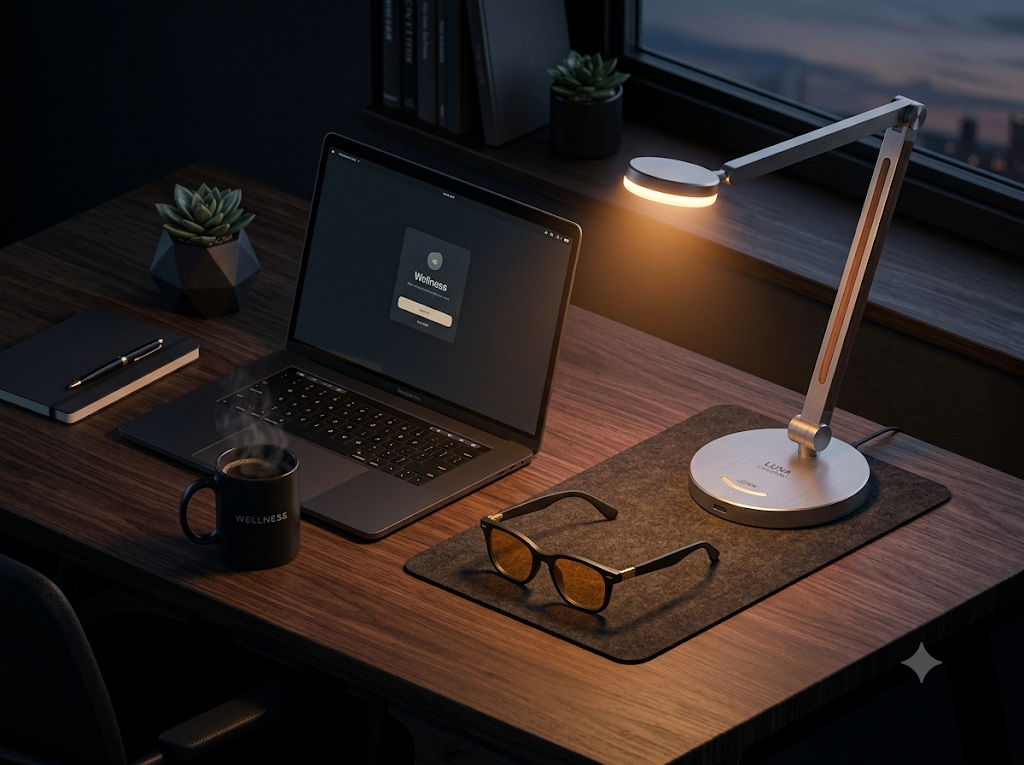
For digital founders, remote developers, and creators spending 10+ hours a day in front of glowing displays, cognitive fatigue often traces back to one root cause: fragmented sleep. When your biological clock falls out of sync with natural solar cycles, deep REM sleep collapses, torching your next-day focus and decision-making clarity.
To reclaim their sleep architecture, tech professionals usually choose between two popular biohacking interventions: Amber Blue-Light Blocking Glasses or Whole-Room Circadian Lighting Setups.
Which approach actually moves the needle on biological recovery? We ran a comprehensive 2026 audit comparing both modalities across cost, biological impact, and daily friction.
⚡ Key Takeaways (TL;DR Executive Summary)
- Blue Light Glasses are affordable ($30–$100), highly portable, and instantly block melatonin-suppressing wavelengths (450–480nm) when wearing screens late at night.
- Circadian Lighting (smart bulbs/panels tuned to color temperature) transforms your entire room environment, signaling your brain naturally without requiring you to wear glasses indoors.
- The Verdict: Glasses win on convenience and targeted protection; environmental lighting wins on psychological comfort and natural habit formation.
The Science: Why Screens Destroy Your Melatonin
Your retinal ganglion cells contain a specialized photopigment called melanopsin, which is uniquely sensitive to blue light wavelengths between 460 and 480 nanometers.
When artificial LEDs, phones, and laptops blast this frequency into your eyes past sundown, your brain interprets it as high noon. Pineal gland melatonin production halts, delaying sleep onset and destroying sleep architecture. To block this disruption, you have two primary physical strategies: filtering the light at your eyes or changing the light in your room.
Comparison Matrix: Glasses vs. Environmental Lighting
| Metric / Feature | Amber Blue-Light Glasses | Circadian Smart Lighting (Bulbs/Panels) |
| Primary Mechanism | Optical light filtration at the retina | Environmental color temperature shifting |
| Wavelength Blocking | 99% of blue & green light (if deep amber) | Eliminates blue output at the fixture level |
| Upfront Cost | $30 – $120 (One-time) | $80 – $300+ (Multi-room smart setup) |
| Portability | High (Travel-friendly) | Zero (Fixed to specific rooms) |
| Social Friction | High (Looking like you’re welding indoors) | Zero (Seamless ambient transition) |
1. Amber Blue-Light Blocking Glasses: The Tactical Shield
Unlike cheap clear-lens computer glasses (which mostly filter glare), serious sleep optimization requires deep amber or red lenses certified to block 98%+ of blue and green light below 550nm.
Pros of Glasses:
- Absolute Control: Wherever you look, the blue light is blocked. Even if you stare at a glowing television or smartphone in a hotel room, your biology remains protected.
- Instant Melatonin Surge: Donning amber glasses 90 minutes before bed triggers a rapid wind-down response, making eyelids heavy within an hour.
Cons of Glasses:
- The “Goggle” Social Problem: Wearing dark orange lenses around family members or during late-night video calls looks eccentric and creates social friction.
- Tunnel Vision: They narrow your color perception at night, making design work or color grading impossible after dark.
2. Circadian Smart Lighting: The Ambient Environment
Instead of strapping filters to your face, circadian lighting automates your physical workspace and bedroom using smart bulbs (like Philips Hue, Nanoleaf, or WiZ) programmed to shift color temperatures dynamically.
- Daytime (8 AM – 4 PM): Crisp 5000K–6500K bright white light to suppress melatonin, maximize alertness, and boost cortisol rhythm.
- Evening (Sunset onwards): Automated drop to a warm 2200K–2700K amber glow, eliminating high-frequency blue spikes from room fixtures.
Pros of Circadian Lighting:
- Zero Behavioral Friction: You don’t have to remember to put anything on. Your environment simply adjusts around you as the sun sets.
- Whole-Room Harmony: Family members and guests benefit from the relaxed atmosphere without wearing specialized eyewear.
Cons of Circadian Lighting:
- High Setup Cost & Complexity: Outfitting an entire apartment or home office requires multiple smart bulbs, gateways, and automation scripts.
- Screen Leakage: Even with warm room lights, staring directly at a 500-nit smartphone screen inches from your face will still disrupt melatonin unless device-level night shifts are enabled.
The Ultimate Protocol: Which Should You Choose?
If you are a remote founder or developer looking to maximize deep sleep and next-day mental clarity, the most effective strategy is a hybrid protocol:
- Get Amber Glasses First: If you travel frequently or share an office where you can’t control overhead lighting, invest in a pair of certified amber night-lock glasses. Wear them 90 minutes before sleep.
- Automate Your Bedroom Lighting: Set your bedside lamps and bedroom fixtures to hard-lock at 2200K warm amber after 8:00 PM.
(Tip: Physical lighting and eye protection work best when paired with mental wind-downs. If late-night screen fatigue has your nervous system fried, pair your sleep setup with our 5-minute NSDR mindfulness protocol to transition into deep REM recovery.)
Frequently Asked Questions (FAQ)
1. Do clear blue-light computer glasses help with sleep?
No. Clear computer glasses are designed primarily to reduce eye strain and glare during daytime work. They do not block the specific 460–480nm wavelengths responsible for suppressing melatonin at night. You need deep amber or red lenses for sleep protection.
2. Can I just use software settings like “Night Shift” or “f.lux”?
Software filters help reduce eye strain, but they are insufficient on their own. OLED and LED screens still emit ambient blue light and high-intensity photons that signal wakefulness to your retinal receptors.
3. How long before bed should I block blue light?
For optimal sleep onset and deep REM cycles, start blocking artificial blue light roughly 90 minutes before your target bedtime.