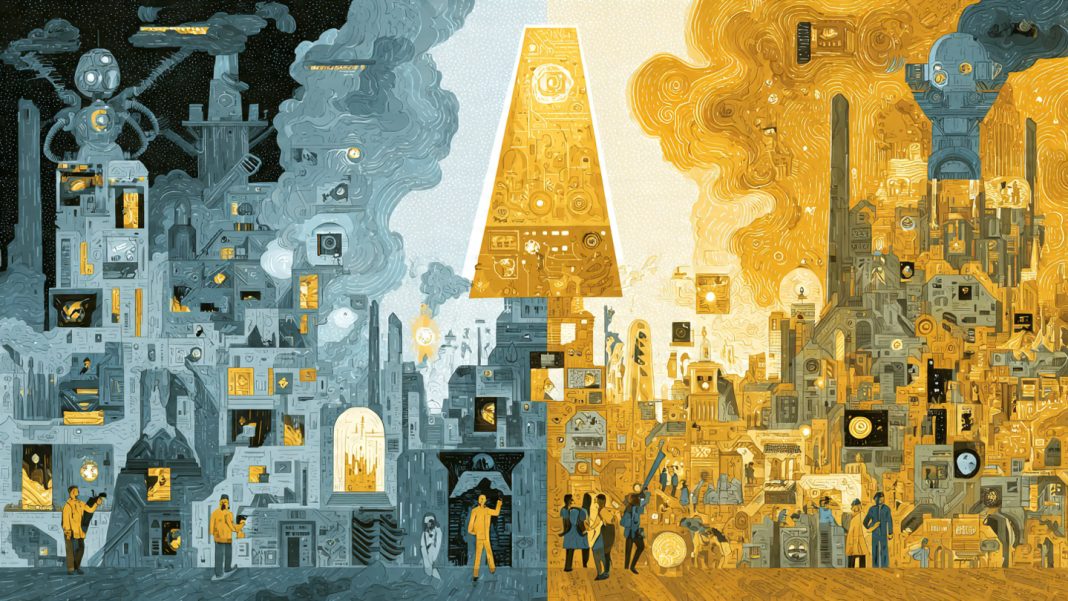
Imagine a world where your basic needs food, shelter, healthcare are guaranteed, regardless of whether you have a job. A world where you’re free to pursue creative passions, care for loved ones, or start a risky venture without the fear of financial ruin. This isn’t a utopian fantasy. It’s a policy proposal called Universal Basic Income (UBI), and in 2026, it’s closer to reality than ever before.
The rapid acceleration of artificial intelligence has thrown the future of work into sharp relief. We are no longer asking if AI will displace jobs, but how many, how fast, and what happens to the people? The answer to that last question, for an increasing number of governments, economists, and technologists, is UBI.
At EthoFuture, we analyze the tectonic shifts at the intersection of technology and humanity. The UBI debate is not just about economics; it’s about our fundamental values—dignity, purpose, and the very meaning of a “good life” in an age of intelligent machines. This is our deep dive into the question: Is Universal Basic Income coming, and what does the AI impact mean for you?
The Perfect Storm: Why UBI Is on the Agenda Now
The concept of a universal basic income isn’t new. Philosophers and utopian thinkers have floated versions of it for centuries. But three converging forces have propelled it from academic fringe to mainstream policy debate in 2026.
1. AI-Driven Job Displacement (The Push)
This is the most immediate and visceral driver. We are no longer talking about automation replacing only manual, repetitive labor. Large Language Models (LLMs) and generative AI are now targeting cognitive, white-collar work.
- The Numbers: A 2024 report from Goldman Sachs estimated that AI could expose the equivalent of 300 million full-time jobs to automation globally . While some of these jobs will be augmented rather than eliminated, the sheer scale of potential disruption is unprecedented.
- The “Hollowing Out” Effect: AI is proving exceptionally good at tasks that once formed the foundation of middle-class careers: writing, coding, data analysis, translation, and even some aspects of law and accounting. This creates a “hollowing out” of the job market, where high-level strategic roles remain (for now), and low-touch service roles persist, but the middle rungs of the career ladder are rapidly disappearing. As we explored in our piece on high-income skills AI won’t replace, the skills that remain are those requiring deep human judgment, creativity, and emotional intelligence—skills that are not evenly distributed.
2. Unprecedented Wealth Concentration (The Pull)
While AI displaces some workers, it is creating enormous wealth for others—specifically, the owners of capital, data, and AI infrastructure.
- The Winner-Take-Most Economy: The nature of digital technology, and AI in particular, tends toward monopolies and “winner-take-most” dynamics. A handful of companies—the “Magnificent Seven” of tech—are capturing a disproportionate share of the value created by AI. This wealth is accruing to shareholders and executives, not to the broader workforce.
- The Tax Base Problem: As labor income is replaced by capital income, the traditional tax base (income tax) erodes. Governments are beginning to grapple with how to fund public services in a world where fewer people draw traditional salaries. This leads them to consider alternatives, like taxing data, AI compute, or the enormous profits of tech giants, and redistributing that wealth through mechanisms like UBI.
3. The “Post-Scarcity” Imagination (The Vision)
Beyond the economic arguments, there’s a cultural shift. For the first time in history, we have the technological capacity to produce enough for everyone’s basic needs. The question is no longer “Can we afford UBI?” but “Do we have the political will to implement it?”
This vision is captured in the concept of the sovereign individual—not as a rugged individualist making it on their own, but as a person freed from the anxiety of subsistence, able to pursue their talents and contribute to society in ways that are not purely economic. A UBI could be the foundation upon which a new era of human flourishing is built.
What Is Universal Basic Income? (And What It’s Not)
Before we go further, let’s clarify the definition. A true Universal Basic Income has five core characteristics:
- Universal: It’s paid to every individual citizen or resident, regardless of their income, employment status, or wealth. No means-testing.
- Basic: It’s sufficient to cover basic living costs—food, shelter, clothing—but not luxurious. The amount is a topic of intense debate.
- Unconditional: There are no work requirements or behavioral conditions. You receive it simply because you exist.
- Individual: It’s paid to individuals, not households, recognizing that resources are not always shared equally within a family.
- Regular: It’s paid at regular intervals (e.g., monthly), not as a one-time windfall.
It’s crucial to distinguish UBI from other social programs:
- Not a Welfare State Replacement: UBI could simplify or replace many existing, bureaucratic welfare programs, but it’s not necessarily intended to dismantle all social services. Healthcare, education, and disability support would likely remain separate.
- Not a Job Guarantee: A job guarantee program ensures everyone who wants a job has one. UBI gives you the money and lets you decide what to do.
- Not a Cure-All: UBI addresses income insecurity, but it doesn’t solve loneliness, lack of purpose, or the need for community. Those are separate, albeit related, challenges.
The Global UBI Experimentation: What We’re Learning in 2026
UBI is no longer a theoretical abstraction. Dozens of pilot programs around the world are providing real-world data.
| Location | Program Name | Key Details | Key Findings (So Far) |
|---|---|---|---|
| Finland (2017-2018) | Basic Income Experiment | 2,000 unemployed individuals received €560/month, no conditions. | Recipients reported better well-being, less stress, and slightly higher employment than control group. |
| Kenya (Ongoing) | GiveDirectly | Long-term experiment giving regular cash transfers to rural villages. | Increased economic activity, no increase in “wasteful” spending (alcohol/tobacco), improved mental health. |
| California (Stockton, 2019-2021) | SEED | 125 low-income residents received $500/month. | Recipients found full-time employment faster, reported less anxiety and depression. Money was spent primarily on essentials. |
| Wales, UK (2022-2025) | Basic Income Pilot | Care leavers (18-year-olds leaving foster care) receive £1,600/month for 2 years. | Early results show improved mental health, financial stability, and ability to pursue education or training. |
| Germany (2021-2024) | Mein Grundeinkommen | Crowdfunded study giving €1,200/month to 122 people for 3 years. | Recipients reported higher life satisfaction, lower stress, and were more likely to start their own businesses. |
| Canada (Ontario, 2017-2019) | Basic Income Pilot (Cancelled) | 4,000 low-income residents received up to CAD $17,000/year. | Cancelled prematurely, but data showed improvements in health, food security, and education. Participants were more likely to work. |
The Meta-Lesson: Across virtually all experiments, the fears of UBI opponents—that people would stop working, become dependent, or waste the money on vices—have proven unfounded. Instead, recipients use the money to stabilize their lives, invest in education, start businesses, and improve their mental and physical health.
The Economic Arguments: Can We Afford It?
This is the most common and contentious question. The cost of a UBI is undeniably large, but so is the cost of the status quo: poverty, homelessness, healthcare crises, and the lost human potential of millions of people.
Let’s look at a simplified model for the United States:
- Proposed UBI: $1,000 per month ($12,000 per year) for every adult citizen.
- Estimated Cost: For approximately 260 million adults, the gross cost would be around $3.1 trillion annually.
This sounds astronomical, but it’s not the net cost. Proponents argue for funding UBI through a combination of:
- Replacing Existing Welfare Programs: The US already spends over $1 trillion annually on various welfare, social security, and anti-poverty programs. Replacing many of these with a single, streamlined UBI would free up significant funds.
- New Taxes: Taxes on data, AI compute, automation, and financial transactions. A small tax on the windfall profits of AI-driven corporations could generate hundreds of billions.
- Value-Added Tax (VAT) or Consumption Tax: A modest VAT on all goods and services is a common proposal, as it captures value from the entire economy.
- Wealth Tax: A small annual tax on extreme wealth (over $50 million or $1 billion) is gaining traction politically.
The conclusion of many economic analyses is that a modest UBI is financially feasible, especially when combined with the societal savings from reduced crime, improved health, and greater innovation.
The Philosophical Debate: Purpose, Dignity, and the Human Spirit
Beyond the economics lies a deeper, more profound debate. What gives life meaning? Is it work? And if AI takes work, what do we become?
The Case for UBI (Beyond Economics):
- Dignity and Autonomy: UBI provides a foundation of dignity. It says to every citizen: “You matter, regardless of your economic output.” This autonomy allows people to leave abusive jobs, care for aging parents, or pursue artistic passions without the constant threat of destitution.
- Unlocking Human Potential: How many Einsteins or Marie Curies have we lost because they were too busy struggling to survive to develop their talents? UBI could be the greatest engine of human potential the world has ever seen.
- Rewriting the Social Contract: For centuries, our social contract has been based on the exchange of labor for survival. In a world where AI can produce most goods and services, that contract becomes obsolete. UBI is a way to rewrite it, ensuring that everyone shares in the abundance created by technology.
The Case Against UBI:
- Loss of Purpose: Critics argue that work provides more than a paycheck; it provides structure, community, and a sense of purpose. Taking that away, even with a check, could lead to anomie, depression, and social decay.
- Inflationary Pressure: If everyone has more money, won’t landlords and businesses just raise prices, negating the benefit? This is a valid concern that would require careful policy design, such as rent controls and investment in public goods.
- Moral Hazard: Opponents argue that giving people “something for nothing” undermines the work ethic that has driven human progress. It rewards not working, which they see as fundamentally unjust.
- The Funding Burden: Even if feasible, the tax burden required to fund a meaningful UBI would be immense, potentially stifling economic growth and innovation.
The Political Landscape: Where Do We Stand in 2026?
The political winds are shifting. In 2026, UBI is no longer a fringe idea championed only by Silicon Valley futurists.
- European Experiments: Countries like Spain, Finland, and Germany have conducted or are conducting significant pilots. The European Union is actively studying the feasibility of a pan-European basic income scheme.
- US Municipalities: Dozens of US cities, from Compton, California to Gainesville, Florida, are running their own guaranteed income pilots, often funded by philanthropic organizations. These “Mayors for a Guaranteed Income” movement is building a powerful grassroots case.
- Canada’s Evolution: After the premature cancellation of the Ontario pilot, the conversation has shifted. The province of British Columbia is exploring a feasibility study, and the federal Liberal Party has discussed UBI in its policy conventions.
- Developing World Leadership: Kenya’s long-term experiment with GiveDirectly is providing some of the most robust data in the world, showing that cash transfers can be transformative in low-income settings.
- Tech Industry Advocacy: Many tech leaders, including Sam Altman (OpenAI) and Elon Musk, have been vocal supporters of UBI, seeing it as a necessary response to the AI-driven displacement their own industry is creating. Musk has famously stated that “there is a pretty good chance we end up with universal basic income” due to automation .
What UBI Could Mean for You
Let’s bring this global debate down to the individual level. What would a UBI actually mean for your life in 2030?
The Artist: A painter could spend less time waiting tables and more time in the studio, creating work that enriches the culture.
The Caregiver: A daughter caring for an aging parent would receive financial recognition for labor that is currently invisible and unpaid.
The Entrepreneur: A young person with a brilliant idea but no savings could take the leap to start a business, knowing their basic needs are covered.
The Student: A student could choose a field of study based on passion and aptitude, not on its future earning potential to pay off loans.
The Displaced Worker: A 50-year-old factory worker displaced by automation would have a financial cushion to retrain for a new career, start a small business, or transition to a different stage of life with dignity.
Challenges and Open Questions
Despite its promise, UBI is not a panacea, and many questions remain.
- What is the “Right” Amount? Too low, and it doesn’t provide security. Too high, and it becomes unaffordable or disincentivizes work. Finding the sweet spot is a critical policy challenge.
- How Do We Phase It In? Do we start with a universal dividend for children? For seniors? A negative income tax? The transition path matters enormously.
- What About the “Meaning Crisis”? If work is no longer the central organizing principle of society, how do we find meaning? This will require a cultural shift, investing in community, arts, and lifelong learning. The principles of emotional intelligence at work and purpose may become even more critical in a post-work world.
- How Do We Prevent Inflation? Careful macroeconomic policy, including investments in housing and essential goods, would be needed to prevent UBI from simply being eaten up by rising costs.
Conclusion: The Inevitable Conversation
Is Universal Basic Income coming? The honest answer is: it’s not inevitable, but it is increasingly likely. The convergence of AI-driven job displacement, extreme wealth concentration, and successful real-world experiments has made UBI one of the most important political and economic conversations of our time.
The question is no longer “if” we can afford it, but “what kind of society do we want to build?” Do we want a world where a tiny elite captures all the gains of AI, while the rest struggle for scraps? Or do we want a world where the abundance created by intelligent machines is shared, freeing every human being to pursue their potential?
The answer will not be decided by technologists alone. It will be decided by citizens, by voters, by people like you who engage with these questions and demand a future that is not just technologically advanced, but also just and humane.
The UBI debate is, at its core, a debate about who we are and who we want to become. It’s a conversation we must all join.
Aisha Khan is a seasoned Tech Analyst and the EthoFuture lead at Ethonce. She analyzes emerging trends at the intersection of humanity and innovation, with a focus on ethical AI, data privacy, and the future of work. Her insights help readers navigate the complex questions of our rapidly changing world.