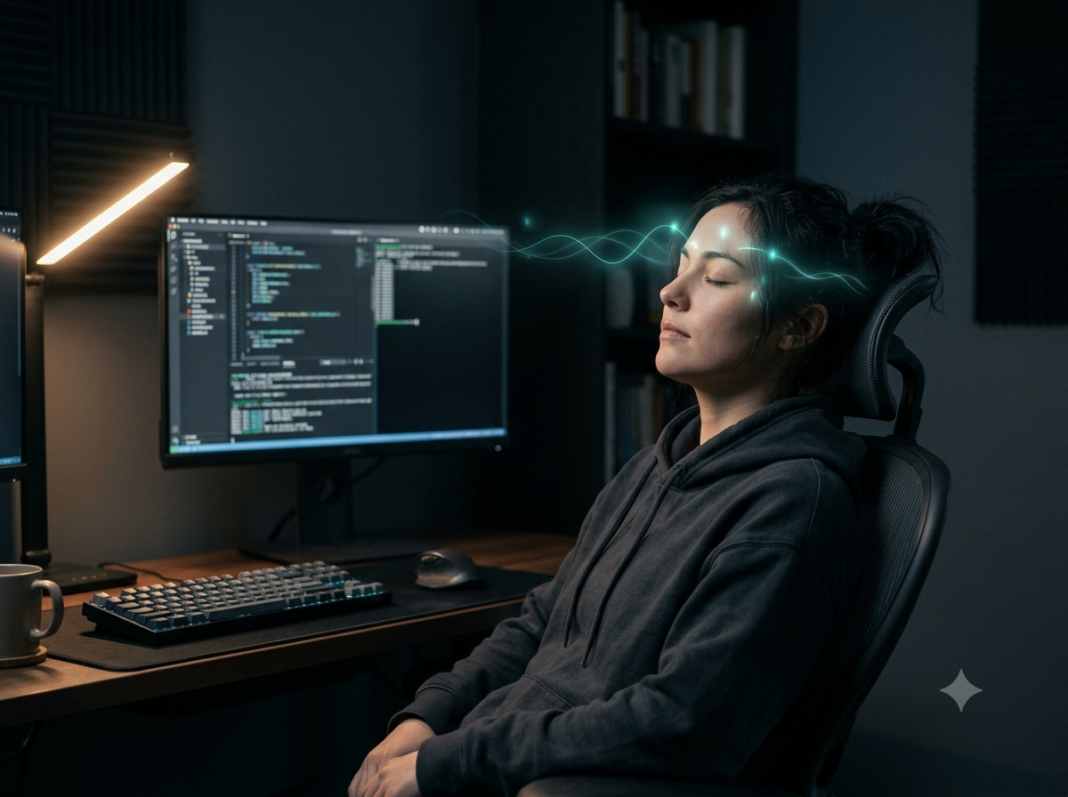
If someone tells you to “just close your eyes and clear your mind” while a production database is throwing 502 errors and your Slack notifications are flashing red, you are going to ignore them. High-performing engineers, founders, and analytical thinkers usually fail at traditional meditation because you cannot think your way out of an overactive nervous system. Instead of spiritual fluff, these 5 minute mindfulness exercises rely on mechanical neurobiology—using Non-Sleep Deep Rest (NSDR), vagal tone stimulation, and ocular decompression to manually downregulate cortisol and restore working memory between deep coding sprints.
⚡ Key Takeaways (TL;DR Executive Summary)
- Bottom-Up vs. Top-Down Control: When your sympathetic nervous system (fight-or-flight) is hijacked by cognitive overload, trying to “calm your thoughts” fails. You must use mechanical body levers—specifically respiratory cadence and visual aperture—to signal safety to your brainstem.
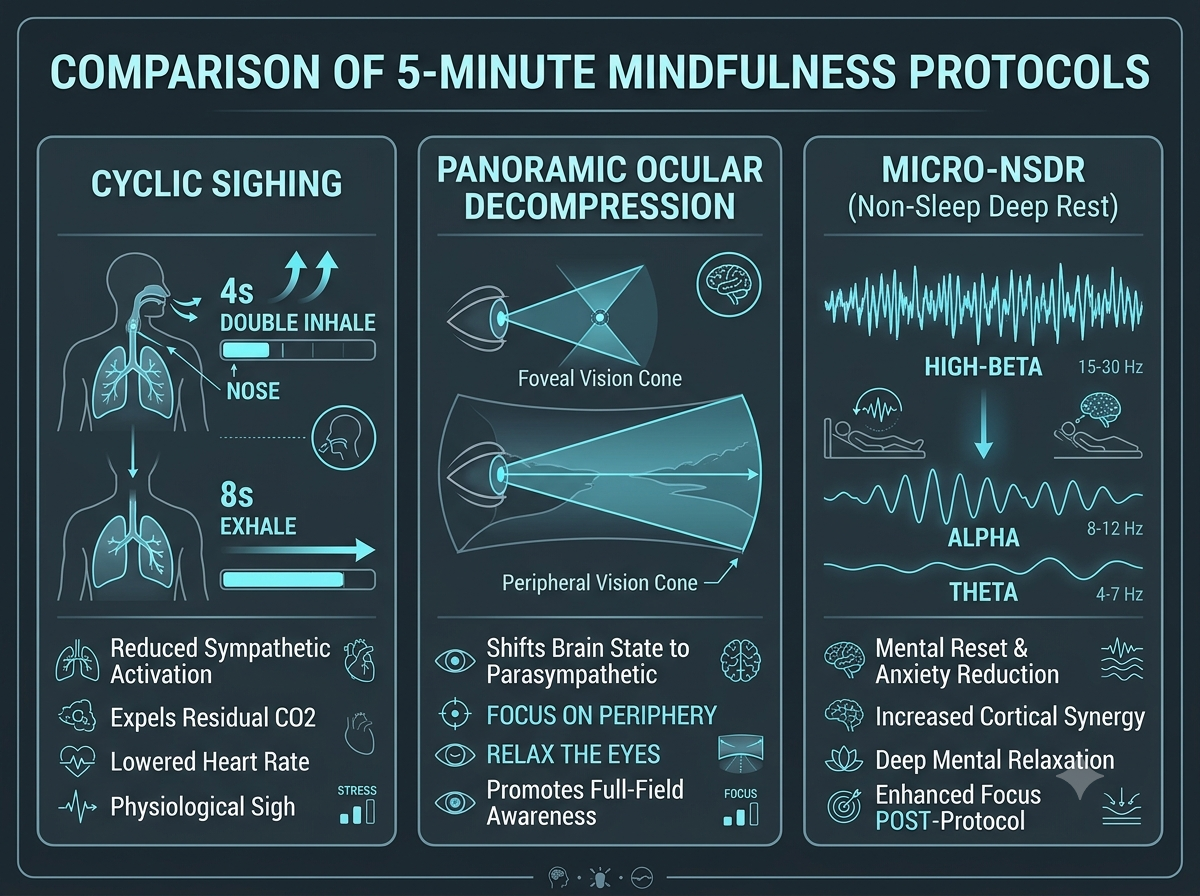
- Protocol #1 (Cyclic Physiological Sighing): A Stanford Medicine clinical trial proved that 5 minutes of exhale-emphasized cyclic sighing (25 respiratory cycles at 12 seconds each) lowers respiratory rate and anxiety faster than traditional mindfulness meditation.
- Protocol #2 (Panoramic Ocular Decompression): Staring at a monitor 20 inches away locks your eyes in vergence, directly stimulating the locus coeruleus (your brain’s norepinephrine/stress hub). Switching to panoramic vision for 300 seconds flips the autonomic brake.
- Protocol #3 (The 5-Minute Desk NSDR): A structured somatic body scan plus box-cadence downshifting clears adenosine buildup and replenishes striatal dopamine after a 90-minute coding block.
Why Traditional Meditation Fails Analytical Brains (Meditation for Skeptics)
Most productivity advice treats the human brain like an isolated philosophical engine. In reality, your prefrontal cortex—the region responsible for debugging complex logic, architectural planning, and impulse control—is governed by your autonomic nervous system (ANS).
When you spend four consecutive hours context-switching between GitHub pull requests, terminal logs, and client calls, your amygdala and locus coeruleus flood your bloodstream with norepinephrine and cortisol. As we explored in our foundational guide on mindfulness for developers and tech workers, asking an analytical brain to “observe thoughts without judgment” during high sympathetic arousal often triggers metacognitive rebound—you simply start overthinking about how badly you are meditating.
This is why meditation for skeptics must be engineered as a physiological state shift, not a spiritual exercise:
- Mechanical Heart Rate Variability (HRV) Coupling: Every time you inhale, your diaphragm moves down, heart volume shrinks slightly, blood flow slows, and your Sinoatrial (SA) node signals the brain to speed up your heart rate. Every time you exhale, the diaphragm rises, heart volume expands, and the parasympathetic vagus nerve releases acetylcholine to slow your heart rate down.
- The Visual-Autonomic Link: Your eyes are not passive cameras; the retinas are literal extensions of your central nervous system (diencephalon). Narrow, high-focus vision (foveal vision) on code syntax tells your brainstem you are hunting or being hunted.
By manipulating these two mechanical switches—breathing ratios and visual focus—you can execute 5 minute mindfulness exercises that work even if you don’t “believe” in mindfulness.
Clinical Comparison: Which 5-Minute Protocol Should You Use?
Different cognitive bottlenecks require different physiological interventions. Before we walk through the step-by-step scripts, use this diagnostic table to match your current mental state to the exact 5-minute protocol:
| Cognitive Symptom / Bottleneck | Primary Neurobiological Cause | Best 5-Minute Protocol | Exact Timing & Cadence | Measurable Physiological Effect |
| Acute Stress, Racing Heart, Pre-Launch Panic | Elevated sympathetic tone & excess $CO_2$ sensitivity | Protocol 1: Cyclic Physiological Sighing | 25 cycles (4s double-inhale + 8s slow exhale = 12s/cycle) | Rapid vagus nerve activation; drops heart rate by 8–14 BPM in 300s |
| Tunnel Vision, Eye Strain, Irritability on Slack | Continuous foveal vergence & locus coeruleus hyper-arousal | Protocol 2: Panoramic Ocular Decompression | 60s distance lock + 240s peripheral expansion | Halts norepinephrine firing; releases ciliary muscle spasm |
| 3 PM Brain Fog, Post-Coding Exhaustion, Sleep Debt | Striatal dopamine depletion & residual adenosine buildup | Protocol 3: Micro-NSDR (Non-Sleep Deep Rest) | 90s somatic scan + 210s alpha-theta downshift | Shifts brainwaves from high-beta (20+ Hz) to restorative alpha/theta (6–10 Hz) |
| Task Paralysis & Attention Residue Between Sprints | Incomplete working-memory buffer clearance | Protocol 4: Tactile Proprioceptive Grounding | 5-4-3-2-1 sensory indexing + 4-4-6 cadence | Clears prefrontal attention residue; restores flow state readiness |
Protocol 1: Cyclic Physiological Sighing (The 25-Cycle Vagal Brake)
If you only learn one tool from this guide, make it Cyclic Sighing. In a landmark randomized controlled trial published in Cell Reports Medicine by researchers at Stanford Medicine, Dr. Andrew Huberman and Dr. David Spiegel compared three 5-minute breathwork practices against 5 minutes of standard mindfulness meditation.
The result? 5 minutes of exhale-focused cyclic sighing produced the largest daily reduction in physiological arousal, respiratory rate, and negative mood—significantly outperforming passive mindfulness meditation.
Why It Works Mechanically
Your lungs contain hundreds of millions of tiny air sacs called alveoli. When you sit hunched over a laptop for hours taking shallow chest breaths, many of these alveoli partially collapse (atelectasis), reducing oxygen exchange efficiency and raising blood carbon dioxide ($CO_2$) levels, which your brain interprets as low-grade anxiety. A double inhale pops those collapsed alveoli open, maximizing surface area so the long exhale can dump excess $CO_2$ and trigger the parasympathetic vagus brake.
Step-by-Step Execution (300 Seconds / 25 Cycles)
Set a silent 5-minute timer on your phone or watch. Keep your eyes closed or softly unfocused on your desk:
- Inhale #1 (3 Seconds via Nose): Take a deep, steady breath in through your nose until your lungs feel roughly 80% full.
- Inhale #2 (1 Second Sharp Top-Off via Nose): Without exhaling, take a second, quick sharp sniff in through your nose to maximally inflate your lungs and pop open the alveoli.
- Extended Exhale (8 Seconds via Mouth): Slowly and smoothly exhale all the air out through slightly pursed lips (as if blowing through a thin straw) for a full 8 seconds until your lungs are completely empty.
- Repeat for 25 Cycles: Each cycle takes exactly 12 seconds ($3\text{s} + 1\text{s} + 8\text{s}$). Completing 25 continuous cycles equals exactly 5 minutes (300 seconds).
If you struggle with chronic work stress, pairing this 25-cycle reset with our burnout self-assessment and recovery signs guide will help you catch sympathetic overload before it turns into clinical exhaustion.
Protocol 2: Panoramic Ocular Decompression (Breaking the Screen Trance)
When you debug code, edit spreadsheets, or read dense documentation, your eyes lock into foveal vergence—a narrow 2-to-5-degree cone of high-acuity vision focused at a fixed distance of 18 to 24 inches.
Neurobiologically, foveal vision is hardwired to your sympathetic nervous system. Every minute your eyes remain converged on a close-range pixel grid, your brainstem’s locus coeruleus drips norepinephrine into your neural circuitry to keep you hyper-vigilant. After 90 minutes, this causes the classic “wired but tired” developer headache.
How to Execute the 5-Minute Ocular Reset
You do not even need to close your eyes for this exercise—making it ideal during boring video calls or while waiting for a Docker container to build:
- Minute 1 (Focal Distance Release): Look away from your monitor toward a window or the farthest wall in your room (at least 20 feet away). Soften your jaw and drop your shoulders away from your ears.
- Minutes 2–4 (Optic Flow & Peripheral Expansion): Keep your head still and gaze straight ahead, but intentionally shift your awareness to the outer edges of your visual field—notice the ceiling above you, the floor below, and the walls to your far left and right simultaneously. This engages your magnocellular visual pathway, which immediately inhibits sympathetic stress signaling.
- Minute 5 (Palming & Tear-Film Reset): Rub your palms together briskly for 5 seconds to generate warmth, cup them gently over your closed eyes without pressing on the eyeballs, and take 5 slow breaths into your lower ribs.
For professionals managing attention deficit challenges, combining panoramic decompression with our natural focus boosters for ADHD brains prevents the mid-afternoon dopamine crash that ruins deep engineering work.
Protocol 3: The 5-Minute Desk NSDR (Non-Sleep Deep Rest)
Coined by Stanford neuroscientist Andrew Huberman and rooted in the ancient practice of Yoga Nidra, Non-Sleep Deep Rest (NSDR) is a self-directed protocol that guides your brain from high-frequency beta waves (alert problem-solving and anxiety) down into the alpha-theta border (6–10 Hz)—the exact state your brain enters during the hypnagogic transition into sleep.
Clinical neuroimaging studies indexed by the National Center for Biotechnology Information (PubMed Central) demonstrate that brief guided deep-rest protocols significantly increase endogenous dopamine release in the striatum (by up to 65% in longer sessions) while accelerating motor learning and working-memory consolidation.
The 5-Minute Micro-NSDR Script (No Audio Track Required)
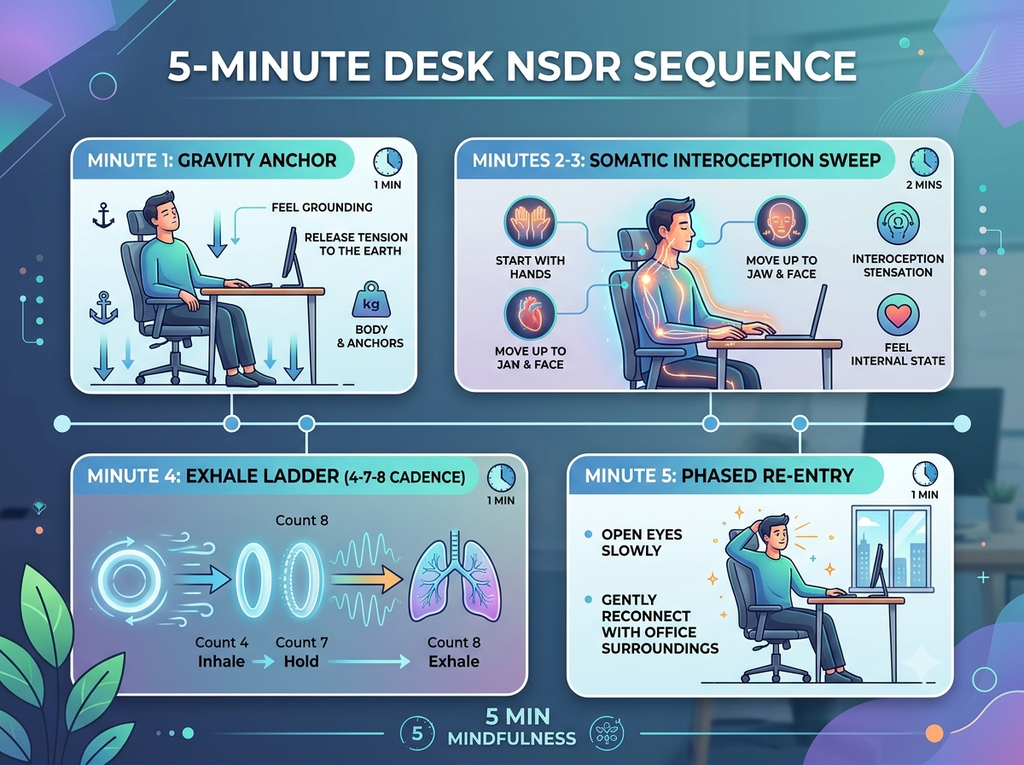
When you hit the dreaded 3 PM afternoon energy crash, do not reach for a third cup of coffee—caffeine merely blocks adenosine receptors without clearing the underlying metabolic fatigue. Instead, lean back in your chair, set a 5-minute timer, and run this four-stage internal sequence:
- Minute 0:00–1:00 (The Gravity Anchor): Close your eyes. Place your hands flat on your thighs. Put 100% of your attention on the physical contact points where your body meets the chair and floor—the weight of your heels on the ground, your thighs against the seat cushion, and your shoulder blades against the backrest. With each exhale, imagine your body sinking 1 millimeter deeper into the chair.
- Minute 1:00–3:00 (Rapid Somatic Aperture Sweep): Instead of thinking about your tasks, move your “mental spotlight” through five high-tension muscle groups for 24 seconds each, consciously releasing micro-contractions:
- Hands & Forearms (unclench fingers from mouse/keyboard tension).
- Suboccipital Neck Muscles (the base of your skull where screen posture strains).
- Masseter & Tongue (drop the tongue from the roof of your mouth; leave a 2mm gap between upper and lower teeth).
- Orbicularis Oculi (relax the tiny muscles around your eyelids and brow).
- Solar Plexus & Belly Wall (allow the abdomen to expand freely on inhalation).
- Minute 3:00–4:30 (The Countdown Exhale Ladder): Inhale naturally for 4 seconds, hold for 2 seconds, and exhale for 6 seconds. Count backward from 8 down to 1 on each exhale. In this 90-second window, your brainwaves dip into restorative alpha-theta frequencies, flushing prefrontal attention residue.
- Minute 4:30–5:00 (Phased Sympathetic Re-Entry): Wiggle your fingers and toes, take two deep inhalations (holding the second one for 3 seconds at the top), and open your eyes slowly to a wide panoramic gaze before looking back at your code editor.
How to Anchor These 5-Minute Resets Into Your Daily Engineering Workflow
Knowing how to perform 5 minute mindfulness exercises is useless if you forget to execute them until you are already burned out at 9 PM. High-output founders and developers use Ultradian Rhythm Stacking rather than random reminders.
The human brain operates on 90-to-120-minute ultradian cycles (Basic Rest-Activity Cycles). During the first 75 minutes of deep work, acetylcholine and dopamine keep your focus sharp. Past the 90-minute mark, error rates spike by over 40% and debugging velocity plummets.
Here is the exact daily schedule to integrate these resets into a busy remote workday without losing a single minute of productive output:
- 08:55 AM (Pre-Sprint Bootup): Run 2 minutes of Panoramic Gaze + 3 minutes of Box Breathing before opening Slack or email. Pair this with our 5-minute morning routines for productivity to lock in high-leverage focus before reactive tasks hijack your day.
- 11:00 AM (Post-Sprint #1 Decompression): After your first 90-minute deep coding or writing block, stand up from your desk and run Protocol 2 (Panoramic Ocular Decompression) looking out a window for 5 minutes.
- 02:30 PM (The Post-Lunch Adenosine Flush): When post-prandial blood sugar dips and brain fog sets in, recline your chair and run Protocol 3 (The 5-Minute Desk NSDR) instead of scrolling social media on your phone.
- 05:30 PM (Workday Shutdown Valve): Before closing your laptop for the evening, perform Protocol 1 (25 Cycles of Physiological Sighing). This acts as a hard neurochemical circuit breaker between “Founder/Engineer Mode” and your personal life, reinforcing healthy digital boundaries for work-life balance.
(Related Cross-Pillar Read: Once you stabilize your daily cognitive energy, see how modern engineers cut their manual workload by 89% in our hands-on DeepSeek vs ChatGPT vs Gemini coding and cost benchmark.)
Frequently Asked Questions (FAQ)
1. Do 5 minute mindfulness exercises actually work, or do you need 20+ minutes?
Yes, 5 minutes is clinically proven to work when using bottom-up physiological protocols. Stanford Medicine’s randomized trial demonstrated that 5 minutes per day of cyclic sighing significantly reduced anxiety, lowered resting respiratory rates, and improved heart rate variability (HRV) over a 28-day period—outperforming longer passive awareness practices for acute stress relief.
2. What is the difference between NSDR and traditional meditation?
Traditional meditation typically requires active cognitive effort to focus on a mantra, breath sensation, or open awareness, which can frustrate analytical thinkers and skeptics. Non-Sleep Deep Rest (NSDR) uses guided somatic body scans and extended exhalations to mechanically slow heart rate and shift brainwaves into the alpha-theta border without requiring you to “control your thoughts.”
3. Why does scrolling on my phone during a 5-minute break make me more tired?
Looking at a smartphone screen during a work break keeps your eyes locked in close-range foveal vergence and floods your working memory with rapid context-switching stimuli. Instead of resting your prefrontal cortex, a 5-minute social media break increases neural fatigue and leaves heavy attention residue when you return to your code.
4. Can I do cyclic sighing before a high-stakes presentation or investor pitch?
Absolutely. In fact, even 2 to 3 physiological sighs (double inhale through the nose, long slow exhale through the mouth) take less than 30 seconds and immediately blunt the spike in heart rate and vocal tremor caused by acute performance adrenaline.
Final Thoughts: Engineer Your Recovery Like You Engineer Your Stack
You would never run a production server at 100% CPU utilization for 14 hours straight without load balancing or memory garbage collection. Yet most founders and developers expect their prefrontal cortex to parse complex logic all day without a single autonomic reset.
Start with one 5-minute protocol today: set a 300-second timer right after your next 90-minute work block and complete 25 cycles of physiological sighing.
Which of these three protocols—Cyclic Sighing, Ocular Decompression, or the 5-Minute Desk NSDR—are you testing in your workflow this week? Share your experience in the comments below, send this protocol to a burned-out teammate, and subscribe to Ethonce for weekly science-backed performance blueprints!