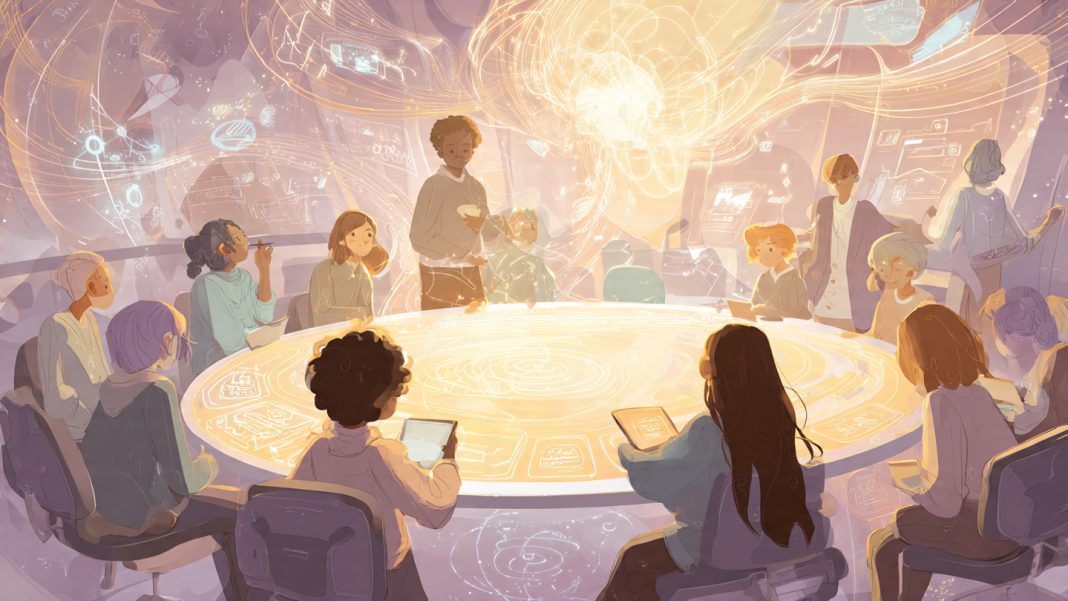
Picture a classroom where every student learns at their own pace, where struggling students get instant, personalized support, and where teachers are freed from administrative drudgery to focus on what they do best: inspiring young minds. This isn’t a distant utopia. It’s happening now, in 2026, as artificial intelligence fundamentally reshapes education around the world.
The question is no longer if AI will transform education, but how—and more importantly, how we prepare the next generation to thrive in an AI-powered world. From intelligent tutoring systems that adapt to each learner’s needs to national AI literacy programs being rolled out across continents, the education landscape is undergoing its most significant transformation since the printing press.
At EthoFuture, we’ve analyzed the latest developments in AI and education—from OECD reports to real-world implementations—to bring you a comprehensive picture of where we stand in 2026 and what it means for students, parents, and educators.
The State of AI in Education: 2026 Snapshot
Artificial intelligence has moved from experimental pilot programs to mainstream adoption in education systems worldwide. According to the OECD Digital Education Outlook 2026, generative AI is now rapidly diffusing across education systems, showing remarkable promise for personalization, feedback, and efficiency . But as the report emphasizes, these benefits are not automatic—they depend entirely on how AI is integrated into pedagogical practice .
Key developments shaping 2026:
| Trend | What It Means |
|---|---|
| Personalized Learning at Scale | AI systems now create customized learning paths for every student, adapting in real-time to their pace, strengths, and struggles. |
| AI Tutors as 24/7 Assistants | From Visual AI tutors to AI learning companions, students can access personalized help anytime, anywhere. |
| Teacher Augmentation, Not Replacement | The consensus across every major report: AI supports teachers—it doesn’t replace them. |
| AI Literacy Becomes Core Curriculum | Countries and states are mandating AI education, teaching students how AI works and how to use it ethically. |
| Data-Driven Insights | Schools now use AI to analyze learning patterns, identify at-risk students early, and continuously improve instruction. |
The Great Promise: How AI Is Transforming Learning
1. Hyper-Personalized Tutoring for Every Student
The most exciting application of AI in education is its ability to provide one-on-one tutoring at scale. Unlike traditional computer-based training with rigid decision trees, modern AI tutors engage in flexible, adaptive dialogue that adjusts to each learner’s needs .
Real-World Example: Visual AI Takes Center Stage
At CES 2026 in Las Vegas, FIRSTHABIT unveiled Chalk 4.0, a Visual AI Tutor that represents a paradigm shift in how students learn. Unlike text-based chatbots, Chalk 4.0 uses Visual Large Language Model (LLM) technology to interact with students through real-time animations and diagrams .
Here’s how it works: A student struggling with a math problem can simply take a photo of their work. The AI scans it, identifies exactly where they’re stuck, and guides them step-by-step toward the correct answer—using visual representations to make abstract concepts clear .
The results are impressive. Beta tests in Korea and the United States achieved a 76.4 percent completion rate, nearly five times higher than traditional e-learning programs . Students aren’t just getting answers; they’re building genuine understanding.
Why This Matters: The system is built on a Cognition Model that prioritizes how learners internalize concepts, not just how quickly they can produce correct answers. It represents a fundamental shift from “output-oriented” to “process-oriented” learning .
2. AI Learning Companions That Reinforce Knowledge
Another breakthrough in 2026 is the emergence of AI learning companions that work alongside human tutors. Wiingy’s CoTutor, launched in January 2026, addresses a fundamental challenge in education: the forgetting curve .
Research shows that without reinforcement, learners forget up to 70% of new information within 24 hours . CoTutor solves this by transforming each tutoring session into a complete learning experience:
- Personalized podcast summaries: Students can review lessons while commuting or exercising.
- AI-generated lesson summaries: Concise written notes are automatically created.
- Interactive quizzes: Custom quizzes engage students in active recall, proven to improve retention by up to 50%.
- Smart flashcards with spaced repetition: Key concepts are converted into digital flashcards that optimize long-term memory retention .
As Wiingy’s CEO puts it: “Live tutoring is only the first leg of the learning journey. CoTutor provides the crucial second leg, transforming a single tutoring session into a continuous learning experience” .
3. AI That Understands Student Thinking
The most sophisticated AI systems in 2026 don’t just deliver content—they understand how students think. Renaissance, a global leader in education technology, launched Renaissance Intelligence in February 2026, described as the “industry’s first Education Intelligence System” .
This system connects the entire instructional cycle—assessment, grouping, instruction, practice, and proficiency—in one unified workflow . Unlike disconnected apps and siloed data, Renaissance Intelligence:
- Grounds its recommendations in validated assessment data and decades of learning research
- Generates intelligent student groupings dynamically mapped to skills and standards
- Creates rigorous formative assessments tailored to individual students and classrooms
- Delivers dynamic, interactive lessons with an intuitive AI toolset
The key insight: this AI serves educators rather than trying to replace them. Every feature is designed to strengthen teachers’ decision-making with research-grounded, just-in-time insight .
The Teacher’s Evolving Role: Augmentation, Not Replacement
A persistent fear throughout the AI revolution has been: “Will AI replace teachers?” The answer from every major report in 2026 is a resounding no—but the role of teachers is undeniably evolving.
The OECD Framework: Three Modes of Human-AI Collaboration
The OECD Digital Education Outlook 2026 introduces a crucial distinction among three ways AI can interact with teachers :
| Mode | Description | Risk/Benefit |
|---|---|---|
| Replacement | AI performs tasks that traditionally require instructional judgment, like designing lessons or tutoring independently. | Risks eroding teacher-student interaction and diminishing professional expertise. |
| Complementarity | AI handles repetitive tasks (summarizing materials, drafting resources) while teachers make final decisions. | Reduces workload but doesn’t fundamentally reshape instruction. |
| Augmentation | Teachers critically examine, revise, and recontextualize AI outputs within their instructional goals. | The ideal model: Expands and transforms teachers’ professional judgment. |
In the augmentation model, teachers don’t accept AI outputs at face value. They use AI-generated suggestions as springboards for deeper reflection, introducing alternative perspectives that refine their instructional decisions .
Real-World Impact: Saving Teachers 31% of Prep Time
The efficiency gains are already substantial. A study in England involving 259 teachers found that after receiving practice guidance, teachers using AI reduced their lesson planning and resource preparation time by an average of 31 percent—from 81.5 minutes to 56.2 minutes per week—without compromising teaching quality .
Microsoft’s “Teach” App: Empowering Educators
In January 2026, Microsoft launched new AI tools specifically designed for educators. The Teach app, integrated into Microsoft 365 Copilot, helps teachers :
- Generate standards-aligned lesson plans in seconds
- Adjust materials to different reading levels with a single prompt
- Create rubrics and quizzes that focus on critical thinking
As one educator noted: “We’ve seen many AI tutors, but most of them still feel like a black box. What stood out was how clearly it visualized the reasoning process. Students are not just given answers. They can actually see how each step connects” .
The Critical Challenge: Avoiding the “Illusion of Learning”
Despite the promise, experts warn of significant risks. The OECD report highlights a central concern: when students rely too heavily on generative AI, metacognitive engagement tends to decline, creating a dangerous misalignment between task performance and genuine learning .
The Turkey Study: A Cautionary Tale
A randomized controlled trial involving 1,000 Turkish high school students in mathematics revealed a sobering finding: students who used general-purpose AI chatbots during practice performed worse on closed-book knowledge assessments than students who studied independently .
The reason? Over-reliance on AI can lead to what researchers call the “illusion of learning”—formal performance indicators improve without the development of deep understanding and core cognitive skills . Students become dependent on AI as a crutch rather than a tool.
The “Fast vs. Slow” AI Distinction
Dr. Ronald Beghetto, cited in the OECD report, distinguishes between :
- “Fast” AI use: Prioritizes immediate output and quick answers
- “Slow” AI use: Supports iterative exploration and reflection
The latter approach is far more conducive to genuine learning and creative development. Rapid content generation, while efficient, can actually undermine originality and deep understanding .
Building AI Literacy: National Initiatives in 2026
Recognizing that AI literacy is now as fundamental as reading and math, governments worldwide are implementing comprehensive AI education programs.
Philippines: Project AGAP.AI
In January 2026, Philippine President Ferdinand R. Marcos Jr. launched Project AGAP.AI (Accelerating Governance and Adaptive Pedagogy through Artificial Intelligence)—a national initiative to integrate AI use and training in basic education .
The program’s name, “AGAP,” means “to support” or “to bridge” in Filipino, reflecting its mission to connect technology and education . Key components include:
- Developing the Foundational Guidelines on AI in Basic Education, the country’s first national framework for ethical and responsible AI use in schools
- Rolling out a national AI skills training program reaching up to 1.5 million Filipinos, including learners, teachers, and parents
- Partnering with MIT, MIT RAISE, and Day of AI to integrate AI concepts into the basic education curriculum
- Piloting AI-powered tools to enhance classroom instruction and school operations
President Marcos emphasized: “This means that students will learn how AI works, teachers can learn how to integrate AI into their lessons, and parents can guide their children in using AI safely and wisely at home” .
California: Statewide AI Guidance
In the United States, California released its Guidance for the Safe and Effective Use of Artificial Intelligence in California Public Schools in January 2026 . Developed in response to Senate Bill 1288, the guidance supports local educational agencies in navigating AI use in ways that are safe, effective, and aligned with California’s values.
Key focus areas include:
- Data privacy and security
- Academic integrity
- Educator support and professional development
- Instructional practices that prioritize equity and human-centered learning
The UNESCO Position: AI as a Supporting Tool
At a UNESCO roundtable in January 2026, the organization reiterated its key position: artificial intelligence cannot replace teachers but should be used as a supporting tool . UNESCO emphasized the necessity of systemic changes, including:
- Developing clear policies and regulatory frameworks
- Adapting AI tools to pedagogical strategies
- Ensuring continuous professional development for teachers
- Addressing inequalities in access to technologies
AI in Special Education and Accessibility
One of the most powerful applications of AI in education is its ability to level the playing field for students with diverse learning needs.
Microsoft’s AI-powered accessibility tools—live captions, narrator, and immersive reader—are now built directly into Windows 11, the operating system powering many classroom devices . For students with dyslexia, for example, Immersive Reader helps process text-heavy materials, while immersive 3D environments allow them to “see” concepts, bypassing traditional barriers to learning .
As zSpace, a Microsoft partner in education technology, notes: “These features ensure that every student has a seat at the high-tech table” .
The Future of Work Connection: Why This Matters
The transformation of education by AI isn’t happening in a vacuum. It’s directly connected to the changing nature of work itself.
Microsoft’s decision to offer free Microsoft 365 Premium and LinkedIn Premium to college students signals a clear message: AI literacy is the new standard for career readiness . Students who engage with these tools throughout their education are building the “future-proof” skills they need to thrive in an AI-augmented workforce.
As we explored in our guide on high-income skills AI won’t replace, the abilities that remain uniquely human—critical thinking, creativity, emotional intelligence, ethical judgment—are precisely the skills that AI-enhanced education can help cultivate, not undermine.
The Three Pillars of AI-Ready Education
Based on our analysis of global trends and expert recommendations, here’s what a successful AI-integrated education system looks like in 2026.
Pillar 1: Student-Centered AI Literacy
Students need to understand not just how to use AI tools, but how they work, their limitations, and their ethical implications. This includes:
- Understanding how AI models are trained and where biases come from
- Learning to craft effective prompts
- Recognizing when AI output may be unreliable or hallucinated
- Developing the judgment to know when not to use AI
Pillar 2: Teacher Empowerment and Augmentation
Teachers need ongoing professional development to integrate AI effectively. The goal isn’t to make them AI experts, but to help them :
- Recognize when students’ AI use is undermining genuine learning
- Develop professional criteria for adjusting those patterns
- Guide students in using AI as a tool to support thinking, not replace it
- Design learning experiences that leverage AI’s strengths while preserving human connection
Pillar 3: Ethical Frameworks and Guardrails
Every major initiative we’ve examined emphasizes the need for clear ethical guidelines . Key principles include:
- Transparency: Students and teachers should know when and how AI is being used
- Privacy: Student data must be protected with the highest standards
- Equity: AI should bridge gaps, not widen them
- Human oversight: Final decisions always rest with humans
What Parents and Students Should Do Now
If you’re a parent or student wondering how to navigate this new landscape, here’s practical advice.
For Students:
- Use AI as a learning partner, not a shortcut. When you’re stuck, ask the AI to explain the concept, not just give the answer. Practice the “slow” AI approach—use it to explore ideas, reflect, and deepen understanding.
- Develop your unique human skills. As AI gets better at routine cognitive tasks, skills like creativity, empathy, and critical thinking become your competitive advantage.
- Stay curious about how AI works. The more you understand the technology, the better you’ll be at using it effectively and spotting its limitations.
For Parents:
- Engage with your child’s school. Ask about their AI policy and how they’re preparing students for an AI-powered world.
- Model healthy AI use at home. Show your children how you use AI as a tool to enhance your own work and learning.
- Emphasize the human elements. Encourage activities that build creativity, emotional intelligence, and face-to-face collaboration—the skills no AI can replicate.
Conclusion: Education’s Most Exciting Era
We stand at the threshold of education’s most transformative era since the industrial revolution. The integration of AI into classrooms, when done thoughtfully and ethically, offers the possibility of truly personalized learning for every child, support for overburdened teachers, and preparation for a future we can barely imagine.
But technology alone is not the answer. The OECD report concludes that without well-designed regulation, data protection, and robust institutional frameworks, digital technologies may exacerbate inequalities and undermine educational quality rather than enhance it .
The path forward requires collaboration—between technologists and educators, policymakers and parents, students and society. It requires us to be guided not by what AI can do, but by what it should do to support human flourishing.
The next generation deserves nothing less. And in 2026, we have the tools, the knowledge, and the opportunity to build it—together.
Aisha Khan is a seasoned Tech Analyst and the EthoFuture lead at Ethonce. She analyzes emerging trends at the intersection of humanity and innovation, with a focus on ethical AI, education, and the future of work. Her insights help readers navigate the complex questions of our rapidly changing world.